

Measure your soil, let AI tell you what to do
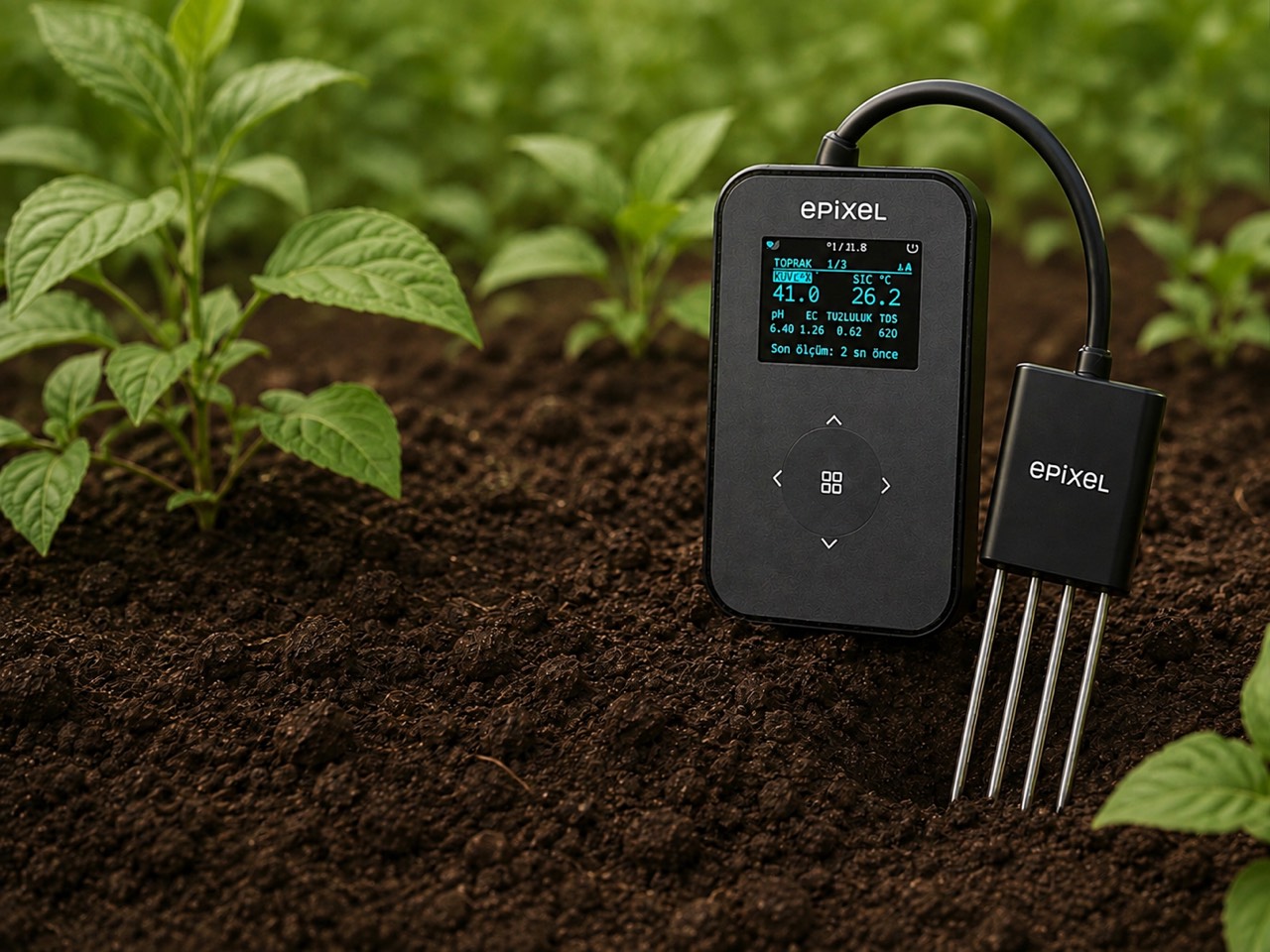
E-Pixel Soil continuously measures moisture, temperature, pH, electrical conductivity, salinity and TDS through a single sensor placed in the ground. An AI-powered agronomy engine interprets this data: it tells you which value is off, how to correct it, and which crops will thrive in that soil. Stop guessing and start deciding with your soil's real data.
Six-parameter soil analysis from a single sensor
Soil moisture, temperature, pH, electrical conductivity (EC), salinity and TDS are measured simultaneously through the same sensor and appear live in the mobile app. Every reading carries a 0-100 quality score, so you can spot a doubtful measurement straight away.
The AI agronomist turns data into action
The AI Agronomist does more than read raw data: it identifies which value is problematic, proposes a concrete action to fix it, and ranks the crops best suited to your soil.
The soil is acidic, moisture is short and salt has started to build up. The three problems feed each other: low moisture concentrates the salt, while acidic pH limits nutrient uptake.
Every detail built for the field
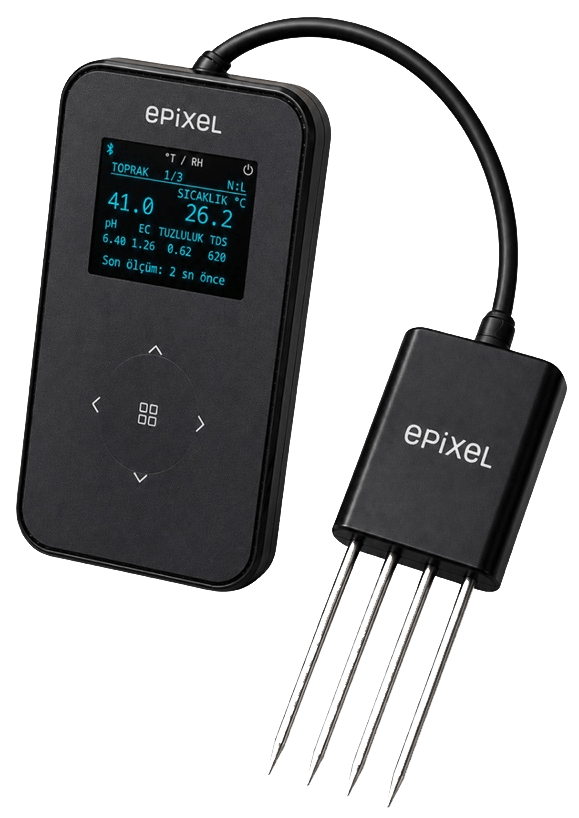
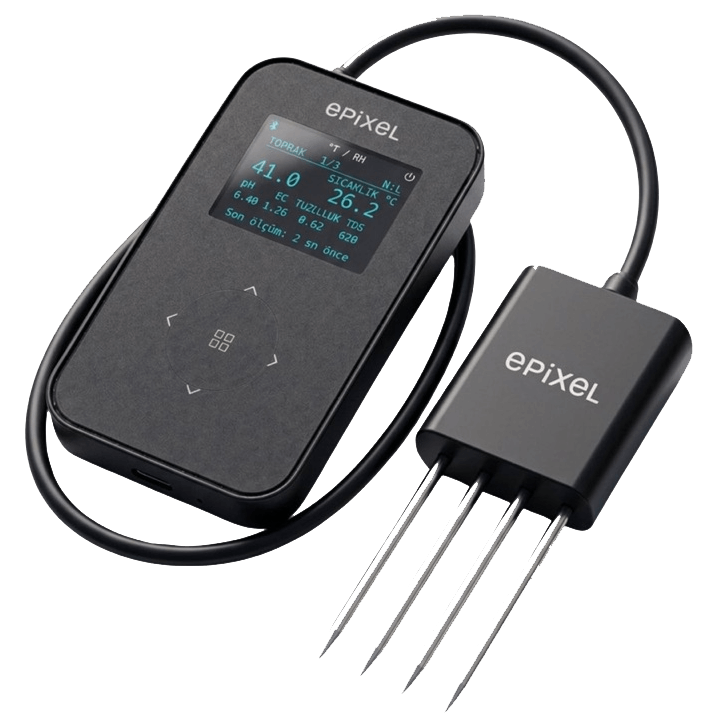
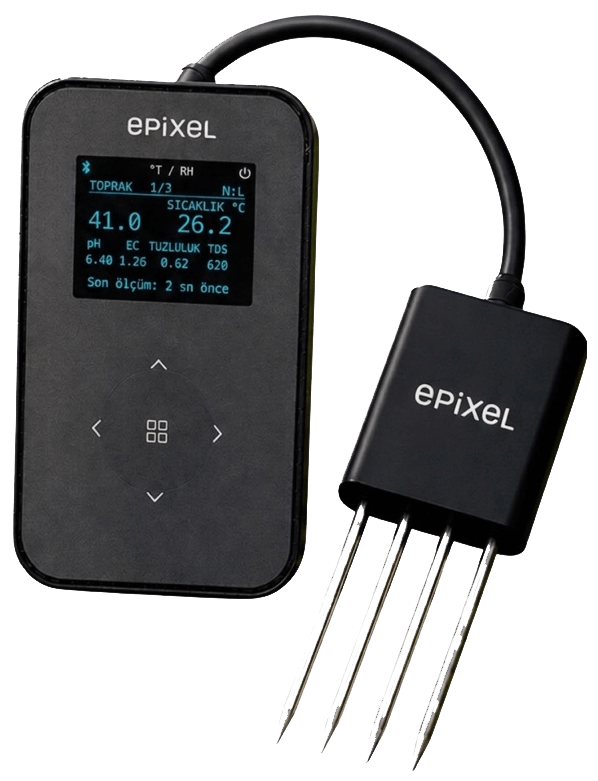
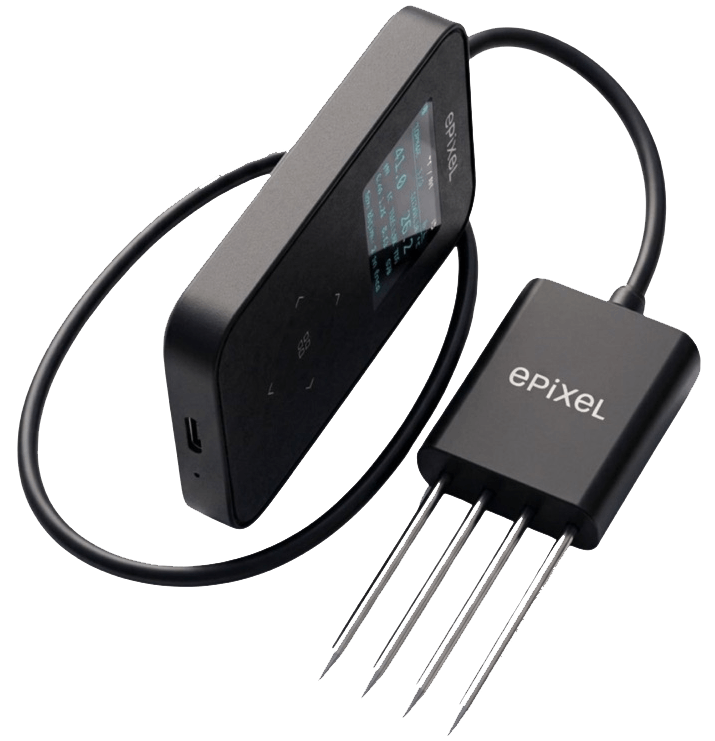
The main unit and the IP67 probe form one system joined by a two metre cable. The probe stays in the soil, the main unit stays in your hand.
Threshold alerts and historical analysis
Set your own threshold for every metric and get an instant notification the moment a value crosses it. You can define quiet hours and still let critical alerts through them. Historical data is kept at raw, minute and hourly resolution, so average, minimum and maximum values show you the trend across the whole season.
Field calibration, laboratory precision
Calibrate in minutes with a reference solution. The app waits for the reading to stabilise, computes the coefficient and writes it to the device's persistent memory.
Every device reports its own spot
Devices connect to the cloud over WiFi. If the connection drops, readings are buffered on the device and uploaded automatically once it returns, so no hour of the field is left without data.
Measured Values
- Soil moisture (volumetric water content, %VWC)
- Soil temperature (°C, negative values included)
- pH (soil acidity)
- Electrical conductivity / EC (µS/cm)
- Salinity and TDS (depends on hardware variant)
- 0-100 quality score for every reading
Mobile App
- Live data stream with instant value cards
- AI Agronomist recommendations and planting guide
- Historical charts (raw / per-minute / hourly)
- Threshold settings, alarms and quiet hours
- Step-by-step calibration wizard
- Device sharing with family or team members
Connectivity & Security
- Cloud connection over WiFi 2.4GHz
- End-to-end TLS encryption with certificate pinning
- Readings are buffered on-device when the link drops
- Buffered data uploads automatically on reconnect
- Over-the-air firmware updates (OTA)
- Per-device authorisation; only the owner and invited users have access
Hardware that survives the field
A main unit with a 1.3 inch OLED display and an IP67 probe on a two metre cable. Touch arrows move between screens, so you can read a measurement on the device itself.
- Main unit
- Soil probe
- USB charging cable
- User manual
- Carrying case
- Sensor buried in the soil
- WiFi pairing from the app
- Step-by-step calibration
- Threshold and alarm setup
Ideal ranges used by the app
When a reading falls outside these bands the app warns you and tells you what to do about it.
- Soil moisture
- 40% ~ 60%
- Temperature
- 15 ~ 28 °C
- pH
- 6.0 ~ 7.5
- Conductivity
- 200 ~ 1500 mS/cm
- TDS
- 150 ~ 500 mg/L
Where is it used?
Wherever soil data matters, Soil earns its place.
Greenhouse Growing
Track the moisture and EC balance of every bed separately. Prevent over-irrigation and fertiliser loss while keeping the root zone in its ideal range.
Field and Garden Farming
Learn your soil's real profile before planting. The AI Agronomist tells you which crop will take hold and which value needs correcting first.
Vineyards and Orchards
In perennial crops, salinisation and pH drift creep in slowly. Season-long trend tracking catches the problem before it costs you a harvest.
Landscaping and Urban Green Spaces
Base irrigation schedules for parks and medians on actual soil moisture; cut water consumption while keeping plants healthy.
Gallery
Explore the E-Pixel Soil display from every angle.
Know your soil.
See your soil's real data with E-Pixel Soil and raise your yield with AI-driven recommendations.
Digital Soil Analysis Device and Soil Moisture Sensor
E-Pixel Soil is a digital soil analysis device and soil moisture sensor that continuously measures six values from a single probe placed in the ground. Soil analysis covers soil moisture, soil temperature, soil pH, electrical conductivity (EC), salinity and TDS, all read simultaneously through the same probe and shown live in the mobile app. Instead of sending samples away and waiting for soil analysis results, this soil testing device shows the real condition of the field or greenhouse with data refreshed every ten seconds. Soil moisture sensor values can also be read on site from the 1.3 inch OLED display; the probe is IP67 rated and operates between -10 and 60 °C.
Soil moisture, soil pH and EC measurement in one sensor
The soil moisture sensor measures volumetric water content as a percentage, so irrigation decisions rest on soil analysis data rather than guesswork. The same probe performs soil pH measurement to report acidity and electrical conductivity measurement to report dissolved salt concentration. In soil analysis, EC is the most practical way to see salt accumulating in the root zone after fertilisation; salinity and TDS complete that picture. Soil temperature is measured including negative values, which feeds directly into planting decisions. Every reading from the soil testing device comes with a quality score from 0 to 100; if probe contact with the soil is poor, the score drops and prevents decisions being made on faulty soil analysis data.
AI Agronomist turns soil analysis data into a task list
Raw soil analysis data on its own is a table most growers find hard to interpret. The AI-powered agronomy engine inside the soil testing device compares measured values against ideal ranges and produces a concrete task list instead of another chart: how much lime to apply when soil pH is low, how to leach when EC is high, when to irrigate when soil moisture drops. It also recommends the crops best suited to the soil profile, with reasoning. Digital soil analysis performed before planting therefore shows which crop is more likely to succeed in that soil and which value needs correcting first.
Soil analysis threshold alarms and season-long trends
A separate threshold can be set for each metric; when soil moisture, soil pH or EC crosses its limit, an instant notification is sent to the mobile app. Quiet hours can be configured, with critical alerts allowed to override them. Historical soil analysis data is stored at raw, minute and hourly resolution, and average, minimum and maximum values reveal the trend across the season. This matters most in vineyards and orchards: salinisation and soil pH drift advance slowly and are invisible in a single reading, but they appear in a soil analysis trend spanning months, early enough to act before yield is lost.
Field calibration and uninterrupted data in the soil testing device
The reliability of a soil testing device depends on its calibration. E-Pixel Soil supports two-point calibration for soil pH and soil moisture and single-point calibration for EC and temperature, guided by a step-by-step wizard in the mobile app. Calibration values are written to the soil moisture sensor's permanent memory and backed up in the cloud, so they are restored even after a reset. The device connects to the cloud over 2.4 GHz WiFi; if the internet drops, soil analysis readings are buffered in the internal 8 MB memory and uploaded automatically once connectivity returns. Communication is encrypted end to end with TLS using certificate pinning, and only the owner and the people they share with can access the device. Firmware updates are delivered over the air.
Soil analysis in greenhouses, fields, orchards and landscaping
In greenhouse and protected cultivation, the soil moisture and EC balance of each section is monitored separately, preventing over-irrigation and fertiliser loss and keeping the root zone in its ideal range. In field and garden farming, digital soil analysis before planting establishes the real soil profile. In vineyards and orchards, long-term salinisation is tracked. In parks and urban green areas, irrigation follows the real moisture shown by the soil moisture sensor rather than a calendar, lowering water consumption while protecting plant health. The soil testing device runs from 5V/2A USB, can optionally use a 2000 mAh Li-Po battery, and ships with a standard two-metre probe cable.
Laboratory soil analysis versus digital soil analysis
Classic soil analysis is done by taking a sample and sending it to a laboratory, with results arriving days later and describing only the moment the sample was taken. Digital soil analysis is built on continuous measurement: the soil moisture sensor reads every ten seconds, soil pH and EC are tracked through the day, and change is visible immediately. The two methods complement rather than replace each other. Laboratory analysis establishes the initial profile; the soil testing device tracks how that profile changes across the season. Because irrigation, fertilisation and harvest decisions depend on daily change, continuous soil analysis data is more useful in practice.
Frequently Asked Questions About Soil Analysis
What does the soil testing device measure?
Soil moisture (volumetric water content, %VWC), soil temperature, soil pH, electrical conductivity (EC), salinity and TDS. Salinity and TDS depend on the hardware variant. Every soil analysis reading also carries a quality score from 0 to 100.
How often is soil analysis performed?
The default measurement period is 10 seconds and is adjustable. Data appears as a live feed in the mobile app, and historical soil analysis records are stored at raw, minute and hourly resolution.
Is soil analysis data lost if the internet goes down?
No. When the connection drops, readings are buffered in the soil moisture sensor's internal 8 MB memory and uploaded to the cloud automatically once connectivity returns.
How are soil pH and moisture calibrated?
Soil pH and moisture support two-point calibration, EC and temperature single-point. The process is guided by a step-by-step wizard in the mobile app. Calibration values are kept in permanent memory and backed up in the cloud.
Can the soil moisture sensor be used outdoors?
The probe is IP67 rated and the operating range is -10 to 60 °C. The standard cable length is two metres.
What does the AI Agronomist recommend after soil analysis?
It compares measured values against ideal ranges and produces actionable advice: lime quantity when soil pH is low, a leaching method when EC is high, irrigation timing when soil moisture drops. It also recommends crops suited to the soil profile.
Can several people follow the soil testing device?
Yes. Device sharing in the mobile app lets family or team members access the same soil analysis data. Authorisation is per device.
Does it replace laboratory soil analysis?
The two complement each other. Laboratory analysis establishes the initial profile; the digital soil analysis device continuously tracks how soil moisture, soil pH and EC change across the season.